AI Song & Cover Music・InsMelo
- 4.3
- Rating
- 100.00K
- Installs
- Free
- Price

 Analysis by App-foxy
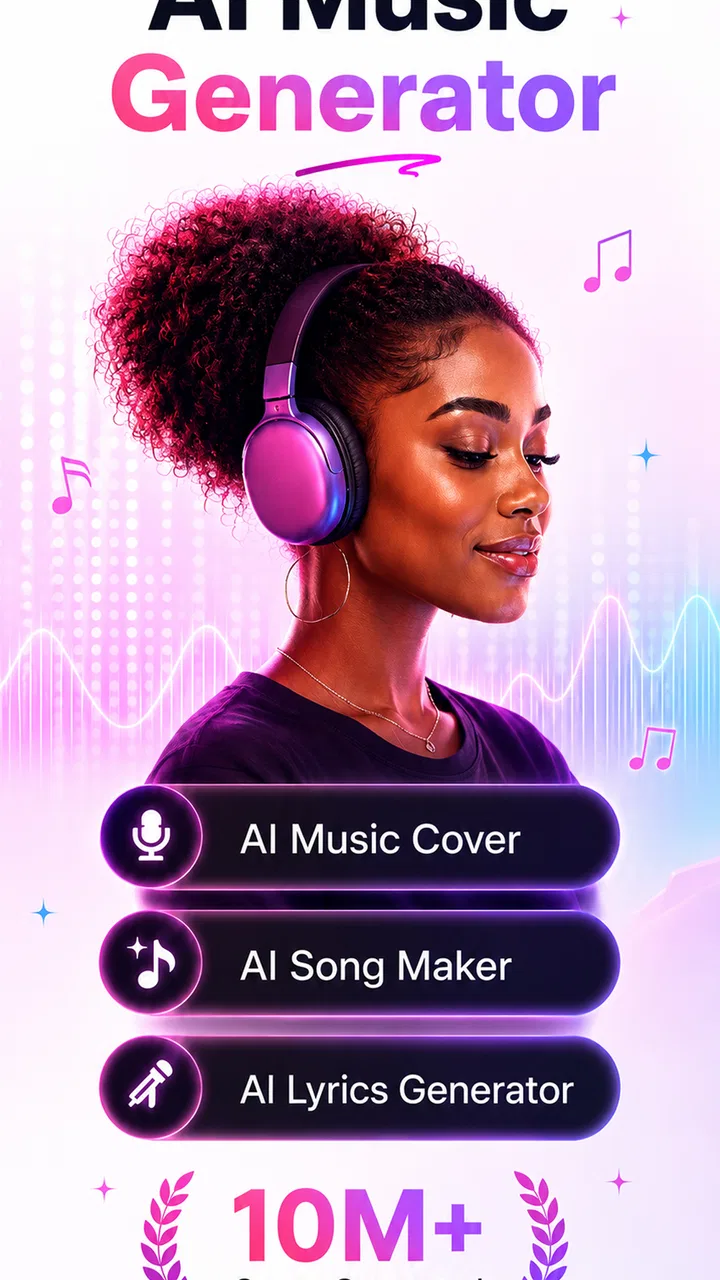
I tried AI Song & Cover Music・InsMelo as a quick way to turn an idea into an AI-made song or cover, and its biggest appeal is immediacy. It belongs to the Music & Audio category, is free to install, and is aimed at people who want to experiment rather than spend an afternoon learning a full production suite. I can imagine opening it on a shared household tablet, making a playful track for a birthday, or testing a chorus before deciding whether it deserves more work elsewhere.
The app comes from AI Mystic Labs and presents itself as a music maker with a video-making angle. That combination matters: I did not approach it like a replacement for a digital audio workstation. I approached it as a fast creative sketchbook, especially useful when the goal is to hear an idea quickly, share a lighthearted result, or explore how an AI interpretation changes the mood of a familiar musical concept.
How InsMelo fits into a shared household
When several people share a device, I’d treat each music-making session as a small group activity with a clear purpose, rather than assuming everyone wants the same kind of result. That makes it easier to agree on what belongs in a prompt and who gets to make the final call before a track is shared. The next section looks at how a few simple habits can keep that workflow enjoyable and manageable.
You May Also Like

 Pandora - Music & Podcasts
Pandora’s Music Is Easy to Start, but Harder to Recover
Pandora’s strength is its low-effort path from a seed to a station. Its weak spot is how much confidence it asks you to place in connection, setup, and quiet recovery.

 8 Ball Pool
 Is Built on Rivalries, Rematches, and Routine
A close look at the rivalries, rematches, shared routines, and unanswered safety questions that turn a quick pool match into a persistent mobile community.

 Samsung Music
’s Quiet Strength Is Playing What You Already Own
Its reach comes less from spectacle than from dependable access to a personal library. That simplicity is both the app’s strongest retention engine and its ceiling.

 AccuWeather: Weather Radar
AccuWeather Review: A Quick, Clear Forecast for Everyday Decisions
For everyday plans, the best forecast is the one you can understand quickly. AccuWeather makes rain timing, radar, and local conditions easy to act on, with a few trade-offs.

 Hill Climb Racing
Why Hill Climb Racing Still Turns Crashes Into One More Run
A tiny car, a bumpy hill and one more upgrade: Hill Climb Racing keeps resurfacing because its simple chaos makes every near-miss feel personal.

 AliExpress - Shopping App
AliExpress Makes Global Shopping Feel Personal, but Shoppers Bear the Risk
AliExpress turns a global marketplace into a pocket-sized discovery engine. Its reach is useful, its shopping loop compelling, and its trade-offs easy to miss.
More From Our News Desk
View All News


A practical family scenario
A realistic use case is a shared device in the living room. One person might want to create a funny song for a family gathering, another may want to try a dramatic cover style, and a younger listener may simply enjoy hearing a short idea transformed. In that setting, InsMelo works best when everyone treats it as a creative activity rather than a personal music library. The app can be passed around for short sessions, with each person bringing a prompt, a song idea, or a different artistic direction.
I particularly like this kind of use because it lowers the pressure to be musically skilled. A person who cannot play an instrument can still participate in the creative decision: choose a theme, suggest a mood, or decide whether a result feels energetic, calm, funny, or deliberately over-the-top. The useful contribution is often the idea before the generation, not technical editing afterward.
There is also a good role for it in small social moments. Someone could make a playful intro for a home video, prepare a musical greeting, or create several contrasting versions of the same concept and let friends choose their favorite. The important expectation is speed and experimentation. If the household wants polished recording, detailed mixing, or precise control over every vocal and instrumental element, a conventional music-production app is likely to be more suitable.
What each person should expect
InsMelo is easier to enjoy when users understand that an AI result is an interpretation, not a guaranteed performance of an exact musical plan. I would encourage a first-time user to begin with a simple idea instead of trying to describe an entire arrangement at once. A clear theme, a recognizable emotional direction, and one intended audience usually produce a more useful starting point than a long, complicated request.
That approach also helps on a shared device because it keeps the session understandable. If several people are taking turns, each person can explain what they were trying to make and why they prefer one result over another. This turns the app into a collaborative prompt-and-listen activity instead of a confusing sequence of unexplained generations.
One non-obvious advantage is that the app can expose the difference between an idea that sounds good in your head and one that works as a complete song. A short concept may feel exciting but lack a clear hook. Hearing an AI version gives me something concrete to evaluate: is the subject strong enough, does the mood match the words, and would anyone remember the central phrase? Even an imperfect result can answer those questions faster than staring at notes.
Keeping personal boundaries clear
Because the app may be used by several people on one device, I would avoid treating a shared session as a private workspace. Before creating anything personal, check who else can access the device and make sure everyone understands which projects are being made for fun and which are intended to remain private. That is a simple household habit, but it prevents awkward moments when a personal idea appears during someone else’s turn.
The same principle applies to generated covers and songs. I would use the app for original concepts, parody-like household activities, and experimentation, while being careful about how finished material is shared publicly. A private family joke and a public upload are not the same situation. If a result uses a recognizable song idea or resembles a known performer, pause before distributing it widely and consider whether you have the necessary rights and permissions.
Setup, boundaries, and everyday workflow
I find that a little planning helps more than repeated trial and error: decide whose idea is being explored, what the result is for, and whether the session should stay within the free experience. Those choices are especially useful when a project might continue later or involve several people’s input. Here’s how I’d set practical boundaries without turning a playful creative session into a formal production process.
Starting without overcomplicating the process
The free entry point makes InsMelo approachable for a quick trial. Its current version is 1.4.003, and it runs on Android devices using version 7.0 or later. That broad compatibility is useful for a household that does not keep every device up to date, although the experience will still depend on the particular phone or tablet and the quality of its connection.
My preferred workflow is deliberately short. I begin with one purpose, create a first version, listen without immediately judging the technical details, and then change one meaningful element at a time. For example, I might keep the subject fixed while changing the mood, or keep the mood fixed while simplifying the wording. This makes it easier to learn what is influencing the result.
A common mistake is to keep generating without taking notes about what changed. On a shared device, that becomes even more confusing because different people may remember different instructions. I recommend writing down the strongest phrase or creative direction before trying another version. That small habit turns random experimentation into a repeatable process.
Where the free model stops being simple
Although the app is free, in-app purchases range from $3.99 to $199.99 per item. That is the point where household coordination becomes important. I would not let a child or guest explore purchase screens without an adult present, and I would agree in advance on whether the app is being used only within its free scope. The visible starting price does not tell you what a particular household will eventually want to spend, so setting a personal limit before experimenting is sensible.
This is also a reason not to hand the device over with a vague instruction such as “make a song.” A better arrangement is to decide what the session is for, how long it should last, and whether anyone is allowed to consider paid options. The app can remain enjoyable without turning every creative attempt into a purchase decision.
The trade-off is straightforward: a free app is convenient for discovering whether AI music creation suits you, but serious or frequent use may lead you toward paid items. I would treat the free experience as a test of the workflow, not as a promise that every desired creative path will remain free.
Making coordination less chaotic
On a shared phone, I would use a simple turn-taking system. Each person gets one idea, one first generation, and one revision before the next person chooses a direction. This prevents the most enthusiastic user from consuming the entire session and gives everyone a fair chance to hear their concept.
It also makes comparisons more meaningful. If two people want a celebratory song, they can use the same broad subject but choose different emotional approaches. One might aim for something warm and sincere, while another chooses a comic tone. Comparing those results teaches more than producing unrelated tracks with no common reference.
For a household project, I would also keep a short naming convention in the notes outside the app, such as the creator’s initials followed by the theme. I am not assuming that InsMelo provides a particular family library or account system; this is simply a practical way to avoid confusion when several people use one device. It is especially helpful if the group returns to the project later and needs to remember which version was meant for which occasion.
When a different music app is better
InsMelo is more convenient than a traditional music workstation when the main challenge is getting from a blank page to an audible idea. A full production app is better when I need precise timing, manual note editing, multitrack recording, detailed effects, or control over an arrangement from beginning to end. Those tools take longer to learn, but they provide the kind of control that an AI-first workflow cannot replace.
It is also different from a standard streaming service. Streaming apps are designed for listening to finished catalogs, while InsMelo is designed around making something new. If a household simply wants background music, a streaming option is the more sensible choice. If the goal is to participate in creating a song, the AI approach is more engaging.
Compared with a conventional karaoke app, InsMelo offers a more exploratory experience. Karaoke is usually about performing along with an established backing track. Here, the attraction is changing the musical idea itself. That is exciting for experimentation, but less suitable for someone who wants a dependable sing-along version with predictable timing.
Age, trust, and responsible use
A broad age rating can make an app feel suitable for everyone, but I still think the person guiding a shared session should consider the prompt, the audience, and any plans to publish the result. That matters when a private joke or personal detail could travel beyond the room in a finished song. The following section considers how to enjoy the creative possibilities while making thoughtful choices about trust and sharing.
Why the Everyone rating still needs adult judgment
The app carries an Everyone content rating, which makes it approachable for a broad audience. I would still treat that rating as a starting point rather than a complete household policy. The creative direction comes from the user, so the tone of a generated song can depend heavily on the words and themes entered. Younger users may need guidance about keeping prompts respectful, avoiding personal information, and checking a result before sharing it.
That is not a criticism of the app specifically; it is a normal consideration for a tool that helps people produce media. A child may understand how to press the creation button without understanding the consequences of publishing a song that includes a friend’s name, private event details, or an unkind joke. An adult’s role is to set those boundaries clearly before the first shared session.
I would also explain that an AI-created voice or musical style should not automatically be treated as a real person’s endorsement or performance. If a result sounds similar to a familiar artist, that does not make it an official recording. This distinction is valuable for children and adults alike, especially when a playful household experiment starts to look polished enough to post online.
Trusting the result without trusting it blindly
One of the most useful habits is to listen critically. AI-generated music can sound convincing in one section and less natural in another. I would check the words for accidental repetition, odd phrasing, unintended meanings, and references that do not belong in the final version. This matters even more when the track is intended for a school event, family celebration, or public audience.
A second useful habit is to separate creation from approval. The person who generates a song does not have to be the person who decides whether it is ready to share. In a household, a quick second listen can catch a problem that the original creator overlooked because they were excited by the idea. That small review step is one of the strongest ways to make the app safer and more enjoyable without making the process feel formal.
Privacy deserves the same attention. I would avoid entering addresses, phone numbers, private family stories, or identifying details into a music prompt. A song can be personal without revealing information that the family would not normally publish. Using fictional names or broad descriptions is a better choice when the track is meant for experimentation.
Who will enjoy it most
I think InsMelo is a strong match for curious beginners, casual creators, social groups, and anyone who wants to test a musical idea quickly. It can also help a songwriter who is stuck on a theme and needs an unexpected interpretation to react to. The AI result does not have to become the finished work; it can function as a creative prompt that reveals a stronger direction.
It is less appropriate for a producer who expects detailed technical control, a singer who needs a precise rehearsal track, or a household that wants a completely predictable experience with no purchase decisions. It is also not my first choice for someone who only wants to listen to professionally released music. In those cases, a specialist production tool, karaoke service, or streaming app would better match the goal.
What the community signals, and what it does not
The app has a 4.3 average from around 5.3 thousand ratings, with over 100 thousand installs. Those figures suggest that many people are willing to try the concept and that it has attracted a meaningful audience. I would read them as evidence of interest, not as proof that every device, prompt, or creative expectation will produce the same experience.
There are also 121 written reviews, which can be useful when you want to look for recurring comments about workflow or compatibility before committing to frequent use. I would focus on reviews that describe a specific task rather than relying only on a star score. Someone making short playful songs has a very different standard from someone expecting a complete professional production environment.
My household verdict
After looking at InsMelo through a shared-device lens, I see it as a friendly creative tool with a clear place in the home: quick musical experiments, collaborative jokes, personal greetings, and early-stage songwriting ideas. Its free installation and accessible concept make it easy to introduce, while the AI approach gives non-musicians a way to participate in making music rather than merely consuming it.
The best results come from adding a little structure. Decide who is using the device, keep personal information out of prompts, review lyrics and sound before sharing, and agree on purchase boundaries before anyone explores the paid side. Those steps are more important than trying to force the app into the role of a complete studio.
I would recommend it to a friend who wants fast, playful creation and is comfortable treating AI output as a draft, experiment, or conversation starter. I would not recommend it as the only music app for a serious producer or as a replacement for dependable karaoke and streaming services. Its real strength is turning a vague musical idea into something you can hear and discuss quickly.
For a household, that makes the app worthwhile when the goal is shared creativity rather than flawless results. Give each person room to try an idea, keep expectations realistic, and judge the finished track with the same care you would give any media made for other people to hear. Used that way, AI Mystic Labs’ music app feels less like a shortcut to professional production and more like an accessible creative playground.
FAQs for AI Song & Cover Music・InsMelo
01What is AI Song & Cover Music・InsMelo?
AI Song & Cover Music・InsMelo is an AI-powered music creation app designed for users who want to generate songs, experiment with vocal covers, and explore different musical styles. After reviewing its main features, the app appears aimed at both casual users and aspiring creators, offering an accessible way to turn ideas into music without requiring advanced recording, arranging, or production skills.
02How does AI Song & Cover Music・InsMelo create songs and covers?
InsMelo generally uses artificial intelligence to process your prompts, lyrics, musical preferences, or selected source material and produce an original song or AI-assisted cover. Depending on the available tools and subscription level, you may be able to choose genres, moods, vocal styles, or arrangements. Results can vary, so users should expect to make several attempts before achieving the sound they want.
03Is AI Song & Cover Music・InsMelo free to use?
The app may offer free access to selected features, trial generations, or limited daily usage, while more advanced tools can require in-app purchases or a subscription. Before downloading or starting a generation, check the current pricing, renewal terms, credit limits, and trial conditions shown in the App Store or Google Play listing. AI music generation can also consume credits quickly.
04Can I use the songs created with InsMelo commercially?
Commercial usage depends on InsMelo’s current licensing policy, the plan you are using, and whether the generated material includes copyrighted lyrics, melodies, recordings, or recognizable artist styles. Do not assume that every AI-created track is automatically safe for monetization. Review the app’s terms and copyright guidance carefully, especially before uploading music to streaming platforms, social networks, advertisements, or other commercial projects.
05Does InsMelo require an internet connection, and is my content private?
AI music generation normally requires an active internet connection because your prompts, lyrics, audio, or other inputs may be processed on remote servers. Users should review the app’s privacy policy to understand how recordings, generated tracks, account information, and uploaded content are stored or used. Avoid submitting sensitive personal recordings or copyrighted material unless you are comfortable with the stated data practices.
Pros
- Creates song covers quickly with minimal setup
- Offers a broad selection of AI vocal and music styles
- Useful for experimenting with different vocal interpretations
- Simple interface makes basic cover creation accessible
- Can inspire original songwriting and musical ideas
Cons
- AI vocals may sound unnatural on complex melodies
- Results can vary noticeably between different songs
- Some features or song options may require a subscription
- Processing time may increase for longer audio files
- Generated covers may have restrictions for sharing or commercial use

AI Song & Cover Music・InsMelo
Gallery